Formerly known as Gain Life
How AI Is Transforming Claims Management
Insurance claims have always been a balance between speed, accuracy, and human judgment. As claim volumes increase and expectations rise, traditional processes are struggling to keep up. Artificial intelligence is stepping in to fundamentally change how claims are handled from start to finish.
Rather than simply improving existing workflows, AI is reshaping the way insurers collect, interpret, and act on information throughout the claims lifecycle.
Why claims management is evolving
Claims operations sit at the center of the insurance experience. They are also one of the most operationally complex parts of the business.
Adjusters are expected to:
Review large volumes of documentation
Capture accurate data across systems
Communicate clearly with claimants
Make informed decisions quickly
Much of this work is still manual. As a result, teams face bottlenecks, delays, and inconsistent outcomes.
AI addresses these challenges by reducing reliance on manual effort and introducing real-time intelligence into everyday workflows.
From data capture to decision support
One of the biggest shifts AI introduces is how data is handled.
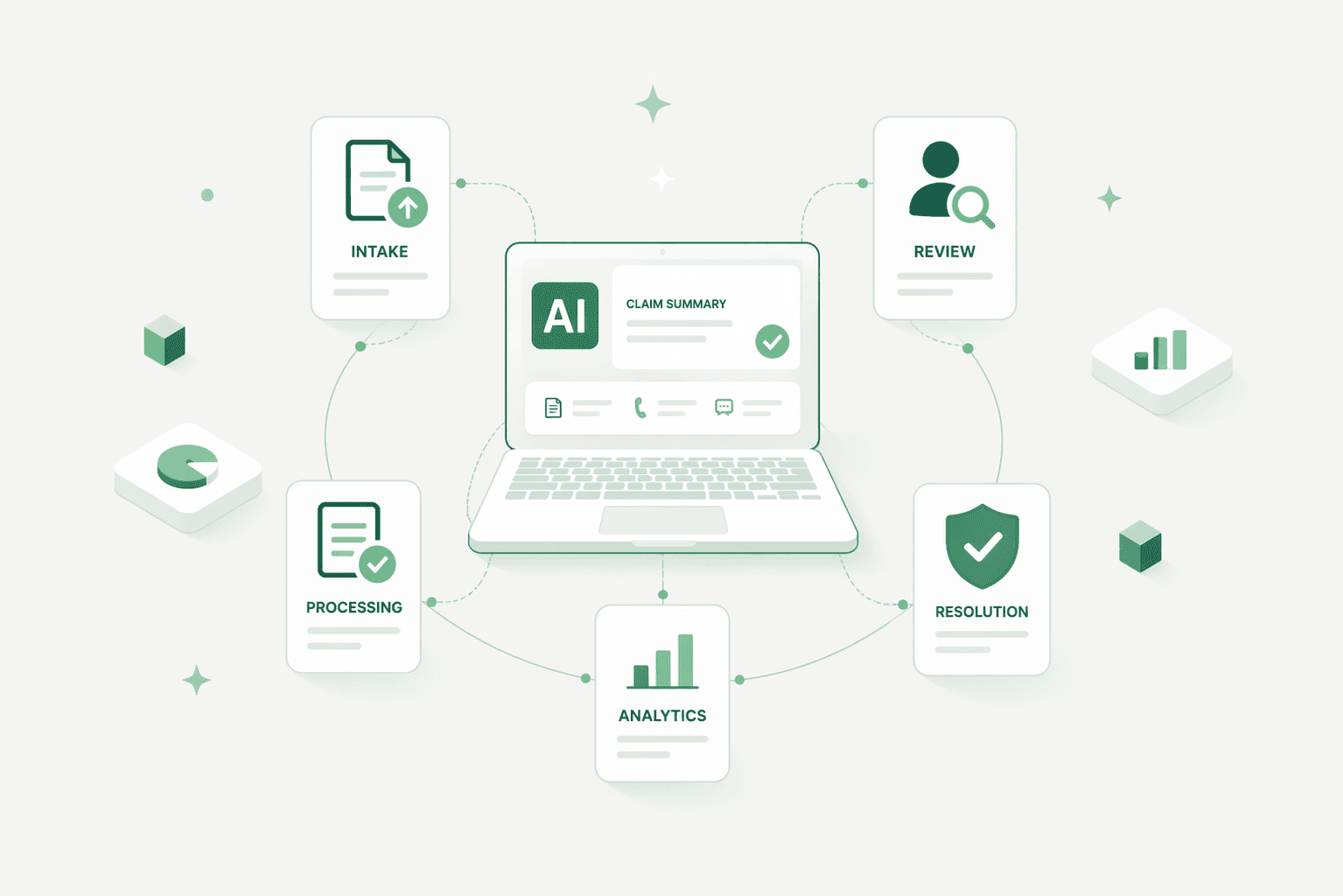
Instead of requiring structured inputs, AI can work with unstructured data such as documents, emails, and voice conversations. This allows insurers to capture and process information much earlier in the claims process.
Examples include:
Automatically extracting key details from medical records and reports
Generating summaries from adjuster calls and claimant conversations
Structuring incoming data so it can be used immediately across systems
This shift reduces the lag between intake and action, allowing claims to move forward faster.
Reducing the administrative burden on adjusters
A large portion of an adjuster’s time is spent on tasks that do not require expertise, such as documentation, data entry, and follow-ups.
AI helps eliminate much of this overhead.
Instead of writing summaries after a call, adjusters can rely on AI-generated transcripts and notes. Instead of manually reviewing every document, AI can highlight relevant sections and extract key data.
This allows adjusters to focus on what actually matters:
Evaluating claims
Making decisions
Supporting claimants
The result is not just increased efficiency, but better use of human expertise.
Improving consistency across claims
Consistency is a major challenge in claims management. Different adjusters may interpret information differently, leading to variations in outcomes.
AI introduces a layer of standardization by:
Applying consistent logic to data extraction
Highlighting relevant signals across all claims
Supporting decision-making with the same inputs
This helps reduce variability and ensures a more uniform claims process across the organization.
Real-time workflows instead of reactive processes
Traditional claims workflows are often reactive. A document is received, reviewed, and then passed along. A call happens, and notes are written afterward.
AI enables a more real-time approach.
Information can be processed as it comes in, triggering next steps automatically. For example:
A document is uploaded and immediately analyzed
A call is completed and summarized instantly
A claim is flagged for review based on detected risk
This reduces delays between steps and keeps claims moving forward without unnecessary pauses.
The impact on claimant experience
For claimants, the benefits of AI are most visible in speed and communication.
Faster processing means:
Quicker responses
Fewer follow-ups
Less waiting for updates
At the same time, automated communication ensures that claimants stay informed throughout the process.
This leads to a more transparent and less frustrating experience, which is critical in moments when trust matters most.
What successful AI adoption looks like
AI is most effective when it is integrated directly into workflows rather than layered on top as a separate tool.
Successful implementations typically focus on:
Embedding AI into intake, communication, and documentation workflows
Connecting AI outputs directly to systems of record
Ensuring visibility and control over how AI is used
The goal is not to add complexity, but to simplify operations.
Final thoughts
AI is no longer a future concept in insurance. It is actively transforming how claims are managed today.
By reducing manual work, improving data handling, and enabling real-time workflows, AI allows insurers to operate more efficiently while delivering better outcomes.
Organizations that embrace this shift will be better positioned to scale, adapt, and compete in an increasingly demanding environment.